

Learn how we are working to transform how we use and produce energy.
Partnerships for Power: Unlocking Scale for Interconnected Minigrids in Nigeria
Lessons learned from the first wave of interconnected minigrids: Insights and Recommendations for Nigeria's Power Sector.
Why we share this work for free
RMI is an independent nonprofit working to accelerate the clean energy transition. We publish research like this to inform decision-makers and drive real-world impact.
Our work is supported by philanthropy as well as partnerships, including fee-for-service engagements. This support makes it possible for us to share our independent insights for free.
If you find this work valuable, you can support it anytime.
Get more insights like this
Stay up to date with the latest research, analysis, and tools from RMI by opting in to receive occasional emails below. You’ll get new reports, event invitations, and practical insights to help us all accelerate the clean energy transition.
Loading form...
Your download should start automatically. If it doesn’t, click the download button below.
This work is made possible by philanthropy
RMI is a nonprofit supported by donors and partners. Philanthropy enables us to produce independent research and make resources like this freely available.
If you find this report valuable, please consider supporting our work. You can also explore how we partner with organizations to drive impact.
Jump to Section
Additional contributors: Suleiman Babamanu, Habiba Daggash, Fauzia Okediji – GEAPP, Olatunde Okeowo
In Nigeria, 150 million people — 75 percent of the population — face unreliable or no access to electricity, with the national grid meeting only 20 percent of demand. Households and businesses spend $12 billion annually on costly fossil fuel generators, while manufacturers allocate up to 40 percent of operating costs to energy. Interconnected minigrids (IMGs) offer a transformative solution by combining distributed energy resources (DERs), like solar PV and batteries, with existing grid infrastructure to deliver reliable, affordable power to underserved communities.
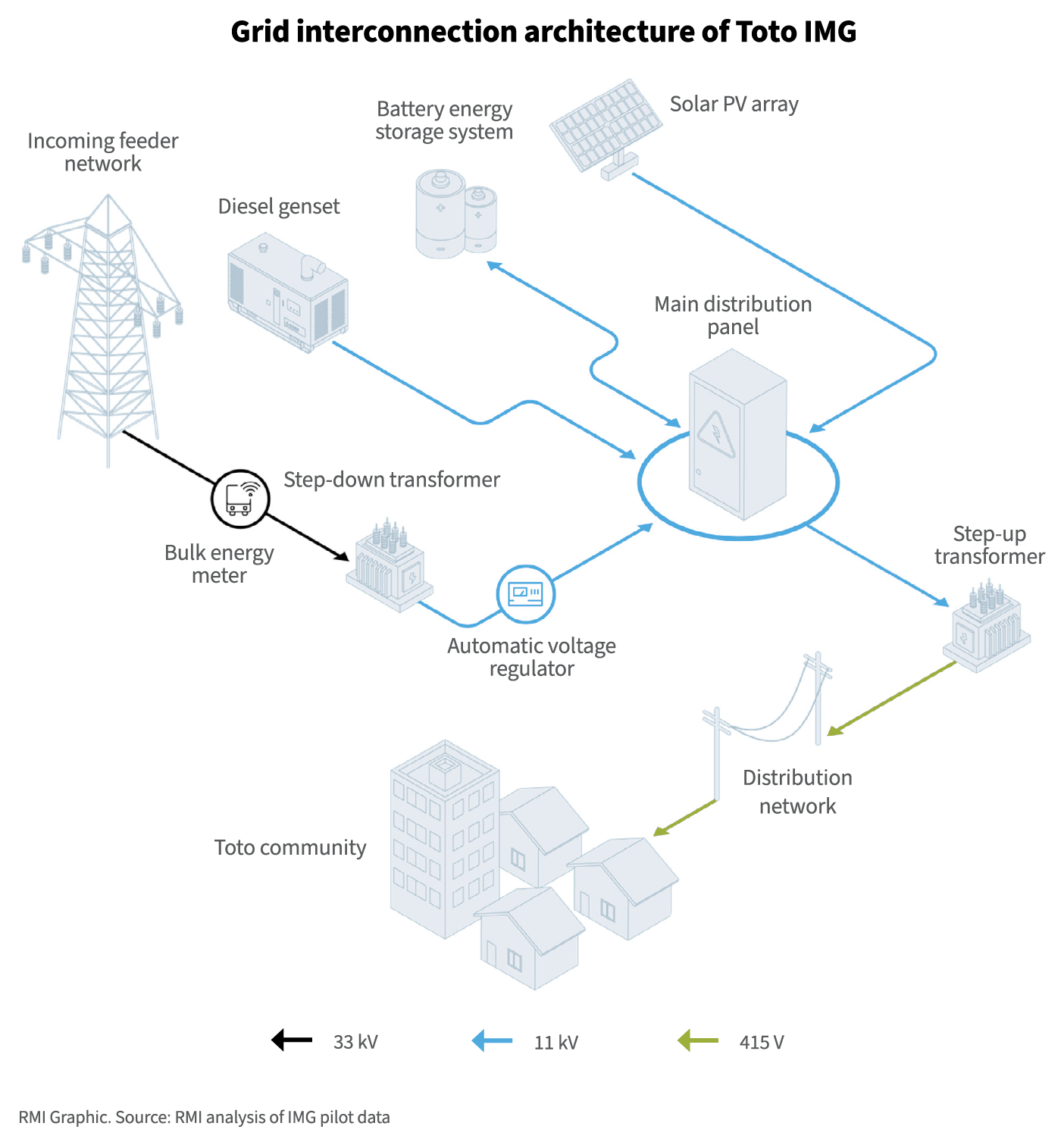
While DERs, particularly solar minigrids, have emerged as a crucial part of the solution, reaching universal energy access demands scalable and complementary approaches. Interconnected minigrids offer a compelling pathway forward. By integrating power from the main grid with on-site renewables, IMGs offer a win-win-win business case, not only providing improved reliability and affordability for underserved communities but also boosting energy sales and reducing losses for distribution companies (DisCos) and providing developers with viable opportunities to expand energy access.
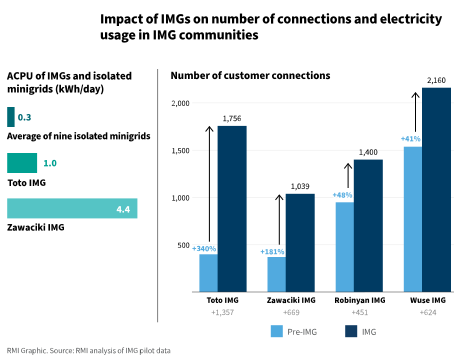
Backed by real-world data and the experiences of pioneering developers, DisCos, RMI, and the Global Energy Alliance for People and Planet (GEAPP), this report delivers critical insights and actionable recommendations to propel the IMG sector forward.
The report:
- Details the proven viability of collaboration between developers and DisCos (also known as utilities) in delivering electricity access, upgrading existing connections, and achieving mutual benefits through IMG projects;
- Identifies opportunities for streamlining project initiation, procurement, construction, and operation to accelerate timelines, reduce uncertainty, and lower costs; and
- Describes challenges hindering faster deployment, such as high up-front generation costs, prolonged project development timelines, unclear interconnection processes and responsibilities, and low DisCo grid supply hours impacting operational expenditures.
To unlock the full potential of IMGs and accelerate energy access for millions of Nigerians, the report offers targeted recommendations:
- Project preparation, design, and execution: Foster stronger collaboration and clearer roles between developers and DisCos, aligning network investments, and optimizing site selection.
- Cost optimization and financing: Encourage larger-scale projects and advocate for public financing to support network upgrades and interconnections, ultimately reducing the cost of electricity.
- Grid infrastructure and development: Promote the use of DisCo-approved contractors, adherence to technical specifications, close coordination, and prioritize data-driven asset management.
- Regulatory and enabling framework: Expand allowable IMG capacities, adapt minigrid regulations to address grid supply tariffs and legacy debt, and establish robust monitoring and enforcement mechanisms.
- Institutional and workforce development: Strengthen governance and grow senior leadership within project developers and foster dedicated DER departments within DisCos or utilities to drive IMG implementation.
This report was made possible by the generous support of the Global Energy Alliance for People and Planet (GEAPP).



Related Insights
Bringing Clean Energy Opportunities to Women and Youth in Nigerian Agriculture


Nigeria’s Electricity Devolution Law Creates an Opportunity to Reshape Its Power System
Help build the clean energy future. Donate today.
Independent research. Real-world solutions. Supported by donors.
RMI can pursue the highest-impact climate and energy solutions because we’re supported by people who believe change is possible. Every gift helps advance the work needed to make clean energy the default choice worldwide.
For other ways to give to RMI, including checks or gifts of stock, please visit Other Ways to Give.
